Limited audit in Switzerland: digital and licensed
Limited audit in Switzerland (eingeschränkte Revision), ordinary audit (ordentliche Revision) and special audits: each one is carried out by a licensed audit expert. We work under the SER, the Swiss standard for the limited audit, and the SA-CH, the Swiss Standards on Auditing, and you receive a quote before the audit begins.
An audit by a licensed audit expert, carried out online, with a quote before the audit begins. Open each line to see what it includes.
Audited by a licensed audit expert
Your audit is led by a Swiss Certified Accountant (eidg. dipl. Wirtschaftsprüferin) and licensed audit expert who worked for several years at one of the four large international audit firms. She is involved from planning to the report, not just for the signature.
Licensed by the RAB
Licensed by the Federal Audit Oversight Authority (Eidgenössische Revisionsaufsichtsbehörde), RAB no. 505484. We carry out limited audits under the SER and ordinary audits under the SA-CH.
No hidden costs
You receive a quote before the audit begins. If additional work arises, for example because documents are missing, we discuss it with you beforehand.
Online instead of in the meeting room
We carry out the limited audit online. We come on site if you wish or if something can be cleared up more quickly in conversation.
Observations included
We tell you what we notice during the audit, even if it does not belong in the audit report. An audit of the internal control system is not part of the limited audit.
Which audit applies to youLimited, ordinary or none at all: the legal thresholds, opting out and the audit on request.
Ordinary audit: the size thresholds
Two of the three values exceeded in two consecutive financial years: total assets of CHF 20 million, revenue of CHF 40 million, 250 full-time positions on annual average.
Ordinary audit: public companies
Regardless of size, if equity securities are listed on a stock exchange or bonds are outstanding. The same applies if your company contributes at least 20 per cent of the assets or revenue to the consolidated accounts of such a company. These audits are reserved for state-supervised audit firms under Art. 727b para. 1 of the Swiss Code of Obligations (CO, Obligationenrecht OR). We do not carry them out.
Ordinary audit: consolidated accounts
If a group is required to prepare consolidated accounts, the parent company has an ordinary audit, even if it is small itself. As a rule, no consolidated accounts are needed if the group as a whole does not exceed the size thresholds (Art. 963a CO).
Limited audit
The normal case for Swiss SMEs. It applies if there is no obligation to have an ordinary audit and nobody requests one (Art. 727a para. 1 CO).
Opting out
Companies with no more than ten full-time positions on annual average can waive the limited audit if all shareholders or members agree (Art. 727a para. 2 CO). Since 2025, only for future financial years and registered before they begin. A company that must have an ordinary audit cannot opt out.
Audit on request
Shareholders holding together at least 10 per cent of the share capital can request an ordinary audit. The articles of association can also provide for one, or the general meeting (Generalversammlung) can resolve to have one. On top of that, banks and investors may make an audit a condition in a contract. That is not a legal obligation but an agreement.
Total assets
CHF20m
One of the three thresholds for the ordinary audit.
Revenue
CHF40m
The second threshold. Two out of three are enough.
Full-time positions
250
The third, calculated as an annual average.
Full-time positions
10
Up to this limit, opting out is possible, with the consent of all shareholders.
This is set out in Art. 727 and 727a CO. The important point: the size thresholds are only one of three legal grounds for the ordinary audit. Public companies and companies required to prepare consolidated accounts have an ordinary audit regardless of their size. That also applies to a company with outstanding bonds and ten employees.
An opt-out also applies to the following years. It lapses as soon as the company has more than ten full-time positions on annual average. In addition, every shareholder can request a limited audit each year, no later than 10 days before the general meeting (Art. 727a para. 4 CO). The general meeting must then elect a statutory auditor. If it approves the annual financial statements without the required audit report, the resolution is void (Art. 731 CO).
Unsure what applies to you?
Five questions, then the answer is there, with the relevant legal provision. No registration required.
How our price comes aboutWhat an audit costs depends on the size, complexity and state of the accounts. Plus a comparison with a named source.
What an audit costs depends on the size, complexity and state of the accounts. For orientation: Gryps, a Swiss quote portal, asked auditors in German-speaking Switzerland what they would charge for specific examples. For a GmbH with ten employees, they quoted CHF 2,400 to 5,000 for a limited audit, CHF 3,600 on average. Our entry price is CHF 2,500, which puts it at the lower end of this range, for a small, well-kept company. A company with several locations, inventory and foreign currencies costs five figures with us too. Four things keep our entry price low. None of them means ‘we look less closely’.
Data instead of binders
We work with account ledgers and reports straight from your accounting software. That saves time on your side and on ours.
Standardised working papers
Our working papers follow the Swiss standard for the limited audit (SER). We do not build them from scratch for every engagement; we adapt them to your risks.
Online instead of in the meeting room
We carry out the limited audit online. That means no travel and no audit weeks on your premises.
We know where errors tend to arise
Because we keep accounts for clients ourselves, we know where things tend to go wrong in an SME’s books. That shortens the search, not the audit.
Independent, even when we know your accounts
If we also keep your accounts, a limited audit would be permitted by law, provided there is personnel and organisational separation: the person who keeps your accounts does not audit them (Art. 729 para. 2 CO), and the involvement must be stated in the audit report (Art. 729b para. 1 no. 3 CO). For an ordinary audit, it is ruled out entirely (Art. 728 para. 2 no. 4 CO). We keep it simpler: if we keep your accounts, we refer you to an independent auditor.
And so that it does not get overlooked: ‘from’ means from. CHF 2,500 applies to a small, well-kept company. You know the price of your audit from our quote before the audit begins. If additional work arises, for example because documents are missing or corrections are needed, we discuss it with you beforehand.
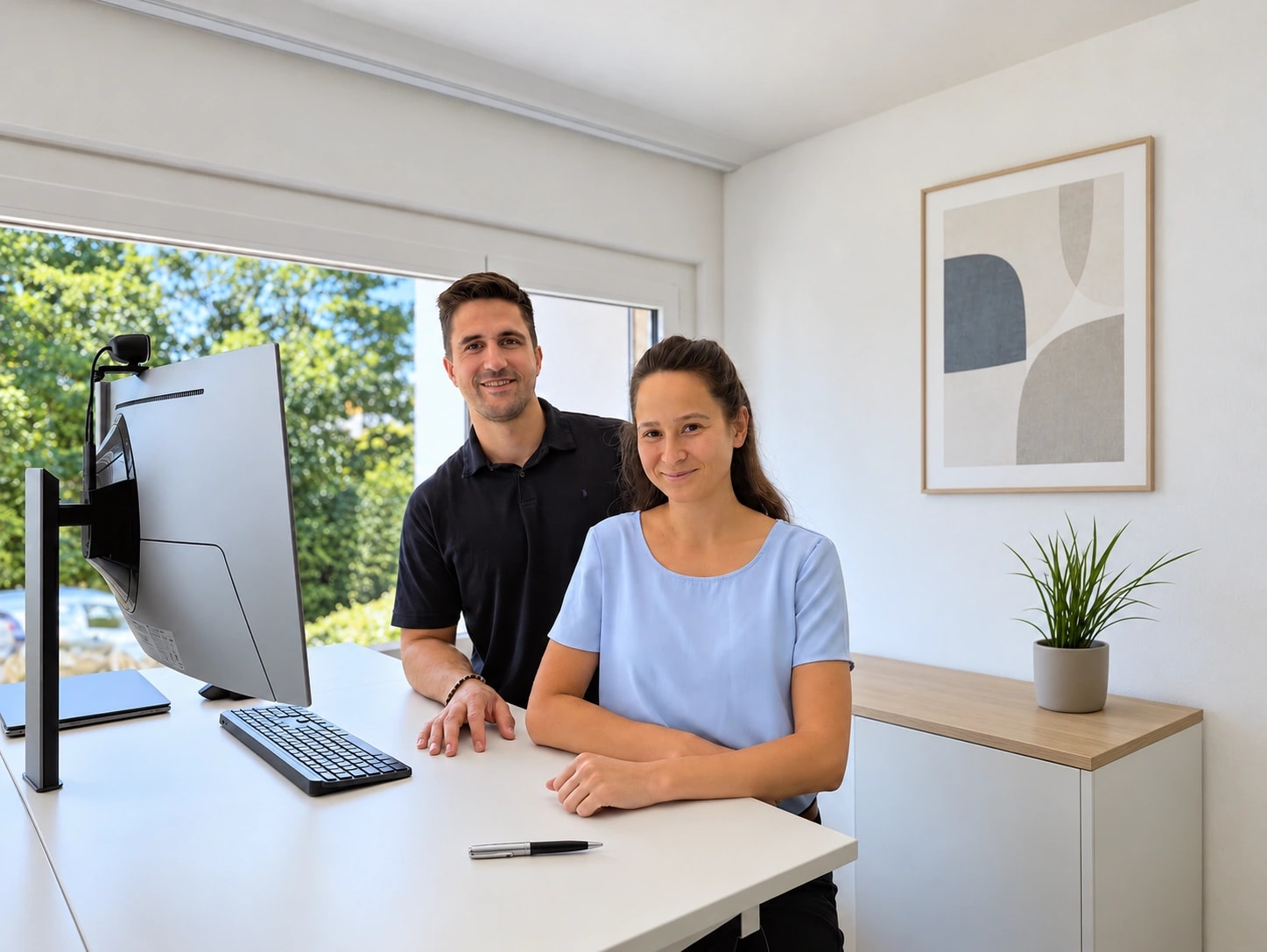
Melanie Giang and Silvio BörlinThe founders of Onaccounting AG. Both of them hold the initial meeting personally.
Who audits
Your audit expert
Your audit is led by Melanie Giang, Swiss Certified Accountant (eidg. dipl. Wirtschaftsprüferin) and licensed audit expert, with several years at one of the four large international audit firms. She is involved from planning to the report, not just for the signature.
Melanie GiangCo-founder
Silvio BörlinCo-founder
EmiliaAccounting & Payroll
OkiAI on the team
HarveyChief Happiness Officer
Kriesbachstrasse 30, 8600 Dübendorf · Monday to Friday, 9 am to 6 pm
Die komplette Auslagerung der Buchhaltung an Onaccounting war für uns die richtige Entscheidung. Alles ist organisiert, transparent und zuverlässig.
JJelena LaurentGoogle review
Zuverlässig, transparent und professionell. Silvio nimmt sich Zeit für Fragen und erklärt komplexe Themen verständlich. Wir fühlen uns als Firma bestens aufgehoben.
CCéline S.Google review
Kompetent, freundlich und effizient. Fragen wurden rasch beantwortet und alles wurde zuverlässig erledigt. Klare Empfehlung!
TTamara WunderlinGoogle review
Schnell, unkompliziert und professionell. Die Firmengründung lief absolut reibungslos.
FFabrizio BrescianiGoogle review
Super Team, sehr freundlich, professionell und engagiert! Kann ich nur weiter empfehlen
AAndreas BrunGoogle review
Professionell und kompetent! Bin sehr zufrieden und kann die Firma nur weiterempfehlen.
VVanessa LutzGoogle review
Immer gut erreichbar und schnell im Antworten!
SSara FornasieroGoogle review
Super Service und sehr freundlich! Sehr zu empfehlen :)
Both entries are public. One click is enough to check them.
Process
How an audit works with us
Three steps. The second decides whether it takes 2 weeks or 2 months. That is why it sets out exactly what we need.
1
Engagement and planning
We check our independence and confirm the engagement in writing. The general meeting elects us as statutory auditor (Revisionsstelle), followed by the entry in the commercial register (Handelsregister). We get a picture of your business and its risks and decide where the audit will focus.
2
Documents and audit
You receive a list of what we need: annual financial statements, the proposal on the appropriation of retained earnings, account ledgers, bank and social insurance statements as at the balance sheet date, contracts, and the minutes of the board of directors and the general meeting. Collected once instead of chased ten times. We then audit online, with inquiries, analytical procedures and appropriate detailed testing (Art. 729a para. 2 CO), and our questions come in batches.
3
Report and general meeting
We discuss findings with you before the report is final, so that you can still make corrections. The board of directors signs a letter of representation (Vollständigkeitserklärung). You receive the audit report early enough to make it available to the shareholders at least 20 days before the general meeting (Art. 699a CO).
The initial meeting
Let’s spend 30 minutes on your audit
The initial meeting is free and without obligation. Together we look at where your business loses time today and which of that work we can take on. Afterwards, you know where you stand.
That depends on size, legal form and your shareholders. For most Swiss SMEs, the limited audit applies. Companies with no more than ten full-time positions on annual average can waive it if all shareholders or members agree (opting out, Art. 727a para. 2 CO). Since 2025, an opt-out only applies to future financial years and must be registered before they begin. Whether that works for you is shown by our audit requirement check, available in German, in no more than five questions.
Who carries out the audit?
A Swiss Certified Accountant (eidg. dipl. Wirtschaftsprüferin) and licensed audit expert who worked for several years at one of the four large international audit firms. She is involved from planning through the audit procedures to the report, not just for the signature at the end. We are licensed by the Federal Audit Oversight Authority under RAB number 505484. We carry out limited audits under the SER, the Swiss standard for the limited audit (Standard zur eingeschränkten Revision), and ordinary audits under the SA-CH, the Swiss Standards on Auditing (Schweizer Standards zur Abschlussprüfung).
How does the entry price of CHF 2,500 come about?
Because we set up the audit differently. We work with account ledgers and reports straight from your accounting software, our working papers follow the SER and are not rebuilt for every engagement but adapted to your risks, and we audit online. On top of that, we keep accounts for clients ourselves and therefore know where things tend to go wrong in an SME’s books. One important point: CHF 2,500 applies to a small, well-kept company. Add several locations, inventory or foreign currencies, and it becomes five figures. What your audit costs is stated in the quote before it begins.
Do you come to our premises for the audit?
We carry out the limited audit online. By law, it relies on inquiries, analytical procedures and appropriate detailed testing of the documents available at your company; attending the stocktake, third-party confirmations and an audit of the internal control system are expressly not part of it. We work in your accounting software, documents and questions are handled in batches, and your business does not come to a standstill because of it. We come on site if you wish or if something can be cleared up more quickly in conversation.
How long does a limited audit take?
For a well-prepared engagement, we expect 1 to 3 weeks between complete documents and the finished report. The bottleneck is almost never the audit, but gathering the documents. Between January and April, every auditor is busier. If your financial year is the calendar year and you ask early, you will get through it more calmly.
Who signs the audit report?
The person who led the audit. That is what the law requires, and the report names this person together with their professional qualification (Art. 729b CO). With us, that is Melanie Giang, Swiss Certified Accountant (eidg. dipl. Wirtschaftsprüferin) and audit expert licensed by the Federal Audit Oversight Authority. She leads your audit from planning to the report and signs it.
Can you audit us if you also keep our accounts?
We do not do it, and the reason is simpler than the legal position. For a limited audit, the law allows the auditor to be involved in the bookkeeping, but it requires personnel and organisational separation: the person who keeps the books does not audit them (Art. 729 para. 2 CO), and the involvement must be disclosed in the audit report (Art. 729b para. 1 no. 3 CO). For an ordinary audit, it is ruled out entirely (Art. 728 para. 2 no. 4 CO). We keep it simple: if we keep your accounts, we refer you to an independent auditor. If you keep them yourself or work with another accountant, we can audit. Which of the two roles we take on for you is something we clarify in the initial meeting.
When do we have to appoint the auditor?
The statutory auditor is elected by the general meeting for one to three financial years (Art. 730a para. 1 CO). Ideally, contact us before the balance sheet date, so that we can plan the audit properly.
How does a change of auditor work?
The general meeting elects us, then we contact the previous auditor and take over the prior-year documents. The entry in the commercial register is updated. The effort for you remains small.
What happens if there are errors in our financial statements?
We raise them before they end up in the report. In most cases, findings can be resolved during the audit. Only if something material remains open is it reflected in the audit report.